
The Federal Ministry of Agriculture and Food Security (FMAFS) has made a significant contribution to the agricultural sector in Jigawa State by donating free agricultural inputs. The donation, which includes 10,000 water pumps, 10,000 knapsack sprayers, 10,000 liters of herbicides, 10,000 liters of pesticides, and 10,000 liters of organic fertilizers, aims to enhance agricultural productivity and food security in the state.
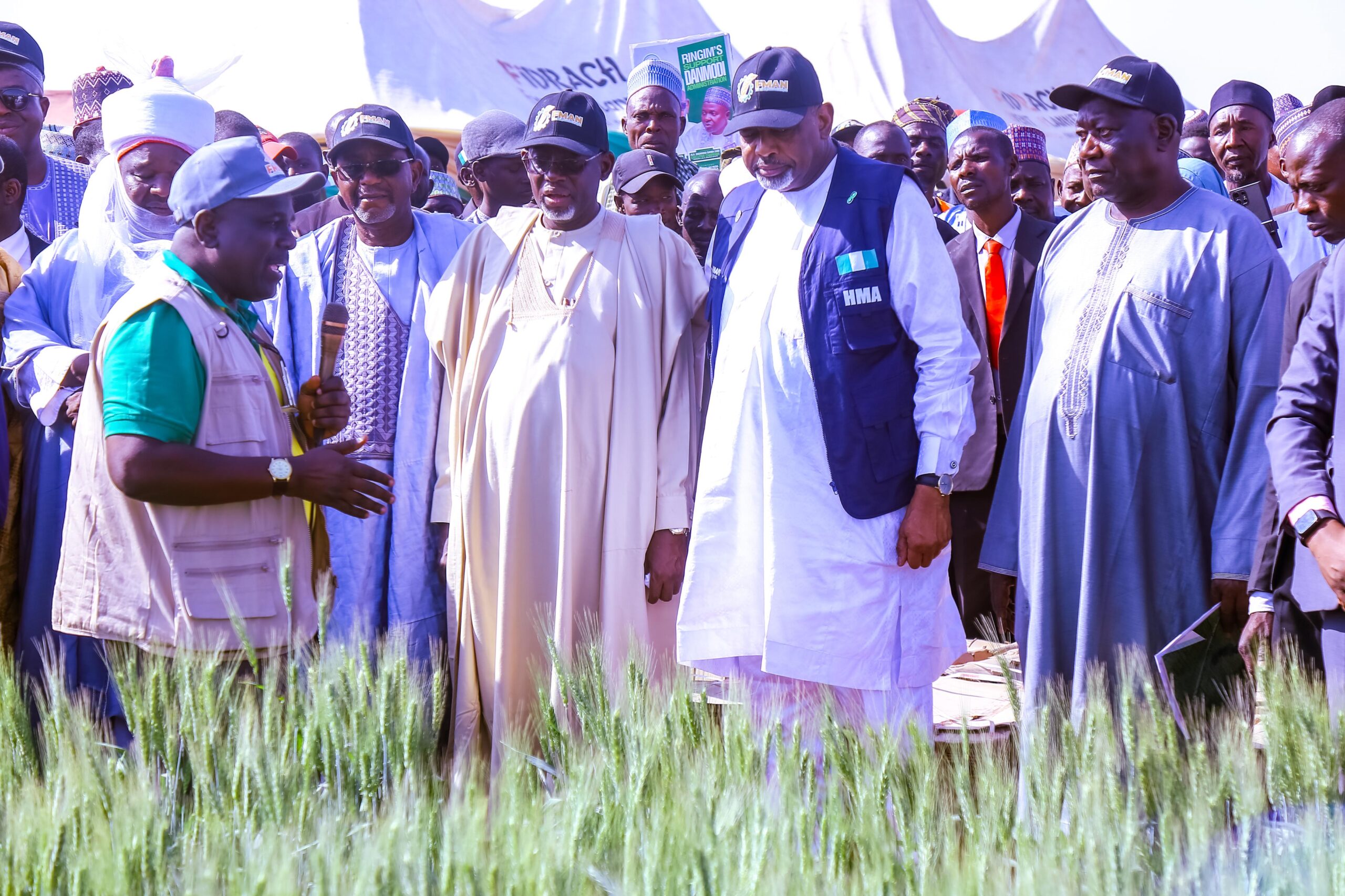
The announcement was made during the 2025 Wheat Farmers Green Field Celebration held in Dabi village, Ringim Local Government Area. The event, organized by the Jigawa State Government in collaboration with the Flour Milling Association of Nigeria (FMAN), brought together key stakeholders in the agricultural sector. Senator Abubakar Kyari, the Minister of Agriculture and Food Security, emphasized that the initiative is designed to support farmers, drive down food inflation, and help them transition from subsistence farming to commercial agribusiness.
“Agriculture is the backbone of Jigawa State’s economy, contributing over 60% of the state’s GDP and employing more than 90% of its population,” Sen. Kyari noted. He highlighted Jigawa’s prominence in food crop production, livestock farming, and cash crop exports, particularly sesame and hibiscus flower, for which the state is a leading producer in Nigeria.
Expanding Wheat Production in Jigawa State
The minister revealed that during the 2023/2024 wheat production season, the Federal Government, through the National Agricultural Growth Scheme and Agro Pocket Programme (NAGS-AP), supported the cultivation of 40,000 hectares of wheat in Jigawa State. The state government and other partners contributed an additional 15,000 hectares, resulting in a total of 55,000 hectares cultivated.
“In that year, the timely provision of inputs at subsidized prices, coupled with the resilience of farmers, led to a bumper harvest,” Kyari stated.
Building on this success, the Federal Government has increased its intervention, now supporting the cultivation of 60,000 hectares, with the state and partners covering an additional 20,000 hectares, bringing the total to 80,000 hectares. More than 160,000 farmers have benefited from subsidized agricultural inputs this season.
Government and Stakeholder Commitments
Governor Umar Namadi of Jigawa State reaffirmed his administration’s commitment to the agricultural sector, recognizing it as a critical driver of food security and economic growth. He expressed appreciation for President Bola Ahmed Tinubu’s Renewed Hope Agenda, which has propelled agricultural innovation in Nigeria.
“In Jigawa State, we are targeting to expand our wheat production to 500,000 hectares by 2030, and we will partner with any potential collaborators to achieve this goal,” Governor Namadi stated.
Dr. Aliyu Samaila, National Program Manager of FMAN, underscored the organization’s role in supporting farmers. “This year, FMAN, in collaboration with the Jigawa State Government, is supporting 10,000 farmers with input loans while training over 50,000 farmers across six wheat-producing states,” he said. He also noted that FMAN has established 200 demonstration farms and centers of excellence to provide farmers with the knowledge and skills required to increase yields and productivity.
Event Highlights
The event featured the distribution of agricultural inputs to smallholder farmers and an inspection of wheat farms in Ringim Local Government Area. Dignitaries in attendance included the Deputy Governor of Jigawa State, the Commissioner of Agriculture and Natural Resources, directors from FMAFS, members of FMAN, and representatives of the All Farmers Association of Nigeria.
With the continued commitment of the federal and state governments, private sector stakeholders, and international organizations, Jigawa State is on track to becoming a major hub for wheat production and agribusiness in Nigeria.